

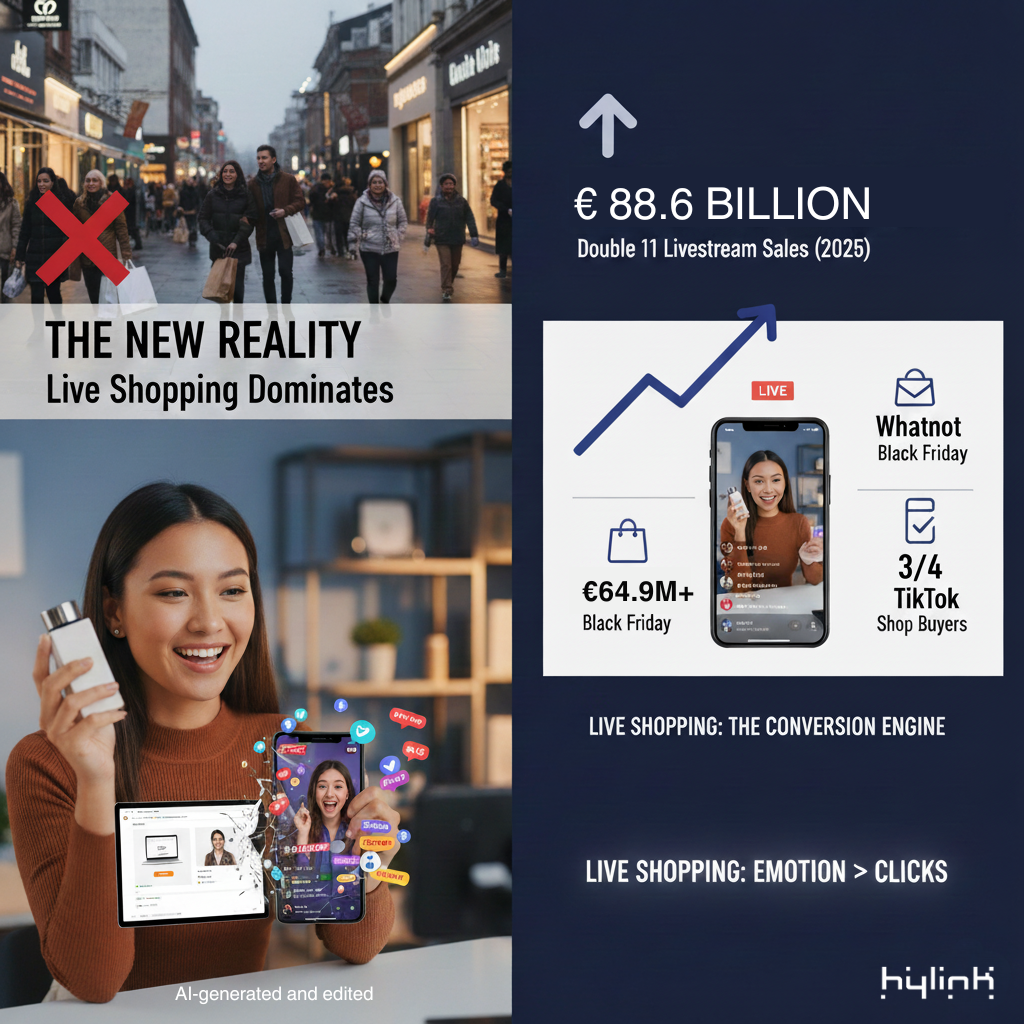
Year-end is traditionally the loudest shopping season. Everyone is searching for festival gifts, treating themselves, or stocking up on seasonal necessities. It’s precisely during these moments of heightened commercial activity that brands compete most intensely for consumer attention. And in this high-season environment, live shopping – with its real-time performance and vivid emotional engagement – stands out in a way that goes far beyond what a typical e-commerce sales loop can deliver.
Livestreaming Takes Centre Stage
Livestreaming shopping remains one of the strongest engines of growth. Livestream e-commerce generated RMB725 billion (€88.6 billion) during Double 11 2025, accounting for roughly 40% of overall GMV. This format is now outperforming display ads as trust and charisma drive conversions.
Globally, the momentum is clear: Emarketer reports that shoppers spent over $75 million (€64.9 million) on the popular liveshopping platform Whatnot across key European markets during Black Friday. Three-quarters of consumers who engaged with TikTok Shop made at least one purchase through a livestream in the past year. Beyond dedicated platforms, global giants like YouTube, TikTok and Chinese channels such as Tmall, WeChat Channel and Xiaohongshu are rapidly expanding their integrated livestreaming shopping features, solidifying their place in the global commerce landscape.
A Shift Toward Rational Consumption & Authenticity
Consumer behaviour in 2025 shows a significant move toward more rational, intentional purchasing. Over one-third of shoppers prioritised planned and necessary buys over impulse purchases. Discounts are still attractive, but decision-making is increasingly anchored in trust, relevance, and emotional resonance – qualities best delivered by a compelling livestream influencer.
Storytelling: The New Conversion Engine
The role of the host is evolving from a salesperson to a genuine storyteller. In China, a follower of domestic top streamer Austin Li described their Double 11 experience: ‘This year, I didn’t just buy a lot of good stuff - I watched all of Austin’s series about his journey ‘Striving for the Driving License’. He shared every difficulty he faced and how he overcame them. We kept watching because we wanted to follow his story.’
This is a powerful example of how live shopping has evolved. The host’s personal narrative builds a connection that extends far beyond promotional content. Viewers return not only for deals, but for continuity, authenticity, and emotional companionship.
Livestreaming as a Daily Ritual
For many shoppers today, livestreaming shopping is no longer a transactional moment - it’s an immersive, companion–like part of daily life. It feels similar to turning on the TV when coming home and chatting with a close friend - except now the ‘friend’ is a trusted host sharing real stories, personal struggles, and everyday moments on platforms like YouTube, TikTok and WeChat.
The Emotional-Functional Loop
This emotional connection reflects the maturity of today’s e-commerce systems: a closed loop from emotional demand to functional purchase. The streamers’ authenticity builds trust; trust drives product belief; and belief accelerates conversion. Livestreaming is becoming an always-on ecosystem where content, community, and commerce reinforce one another.